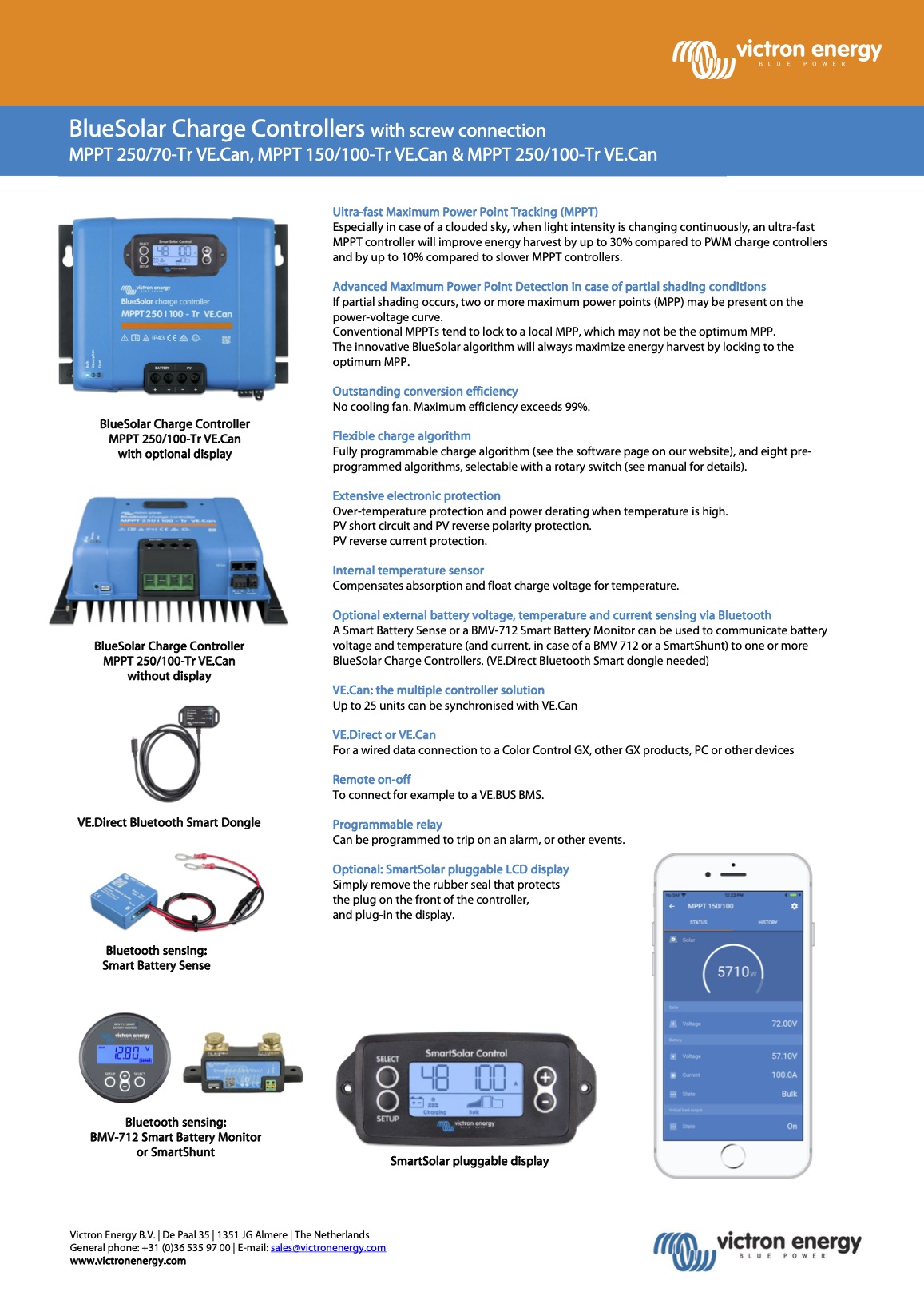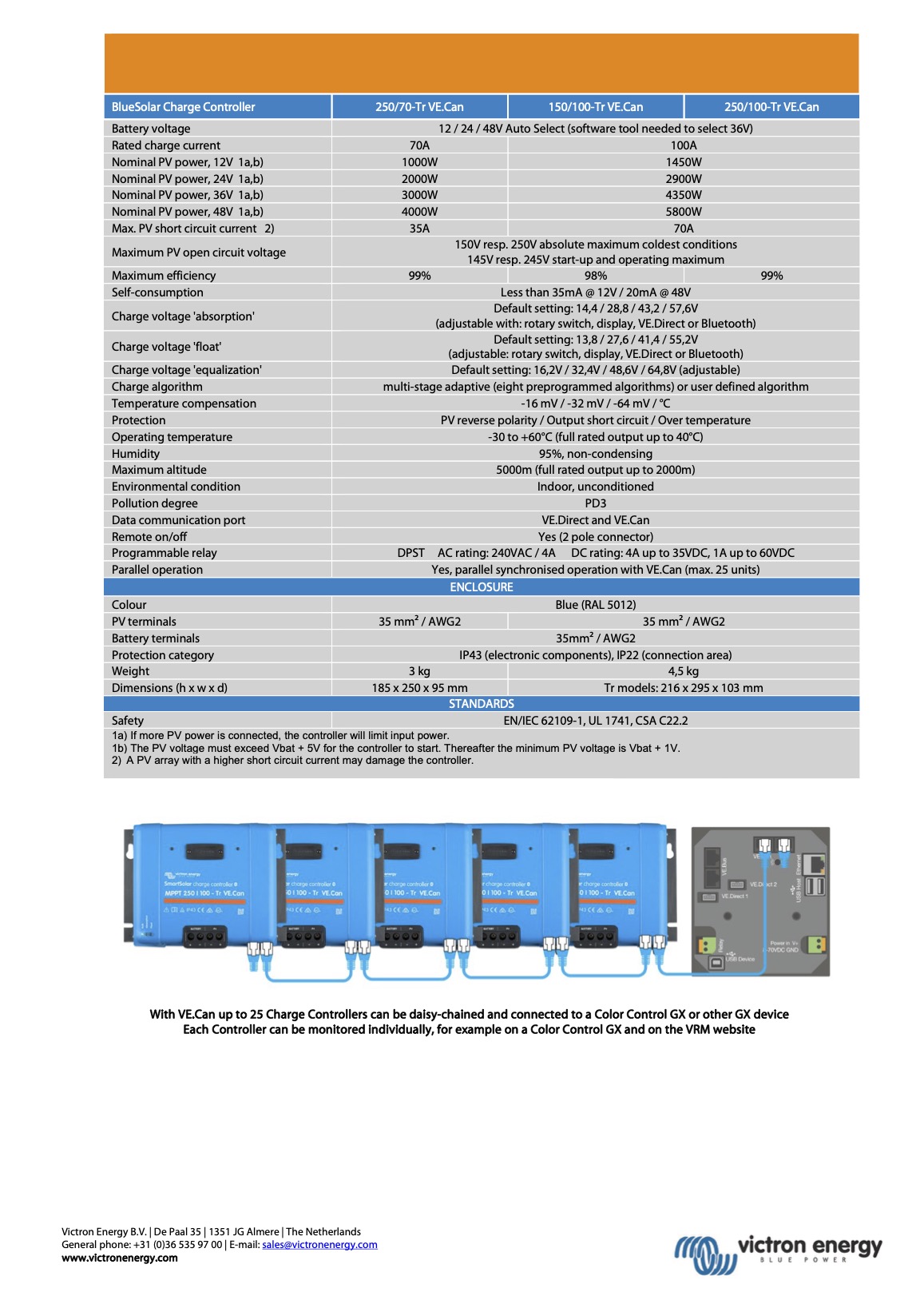
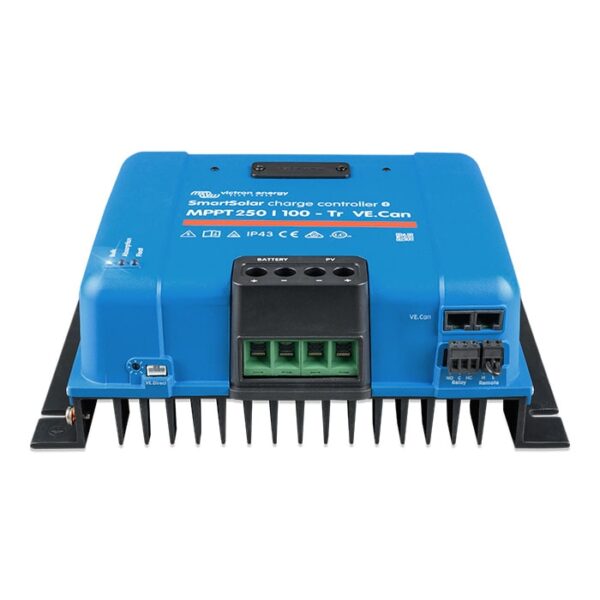
Victron Energy BlueSolar MPPT 250/100-Tr VE.Can charge controller
The solar battery charger collects energy from solar panels and stores it in batteries. Utilizing the latest and fastest technology, BlueSolar maximizes solar efficiency by providing an intelligent charge in the shortest possible time. BlueSolar keeps batteries in good condition, extending their lifespan.
MPPT: ultra-fast maximum power point tracking
By continuously monitoring the voltage and current at the output of your solar (PV) panels, MPPT technology ensures that the available power from the panels is maximized and stored in the batteries. The benefits are especially evident in partly cloudy skies where the light conditions change frequently.
Remote monitoring and control
Remotely control and monitor the advanced features of the BlueSolar MPPT charger by connecting the Bluetooth dongle and connecting it to your smartphone or other device via VictronConnect. If your installation is connected to the Internet with a GX device, the Victron Remote Management (VRM) portal provides access to the full power of the MPPT anytime, anywhere; access to VictronConnect and VRM is free. For remote installations – even if there is no internet connection nearby – you can still control your MPPT by connecting a GlobalLink 520.
Remote monitoring and control
Remotely manage and control the advanced features of the BlueSolar MPPT charger by plugging in the Bluetooth dongle and connecting it to your smartphone or other device via VictronConnect. If your installation is connected to the Internet with a GX device, the Victron Remote Management (VRM) portal provides access to the full power of the MPPT anytime, anywhere; access to VictronConnect and VRM is free. For remote installations – even if there is no internet connection nearby – you can still control your MPPT by connecting a GlobalLink 520.
MAIN CHARACTERISTICS
Battery voltage: 12/24/48 V auto-select (36 V can be selected programmatically) *
Rated photovoltaic power, 12 V 1a,b): 1450 W Rated photovoltaic power, 24 V 1a,b)
: 2900 W Rated photovoltaic power, 36 V 1a,b): 4350 W
Rated photovoltaic power, 48 V 1a : 5800 W
Max. short-circuit photovoltaic current 2): 70 A*
Maximum open circuit voltage of the photovoltaic circuit:
150 V max. 250 V absolute maximum in the coldest conditions
145 V max. 245 V max. at startup and during operation
Maximum efficiency: 99 %
Standalone consumption: Below 35 mA @ 12 V / 20 mA @ 48 V
The voltage of the “absorption” charge:
Default setting 14.4 / 28.8 / 43.2 / 57 ,6 V (Adjustable: by rotary switch, via display, VE.Direct or Bluetooth)
Floating charge voltage: Default setting 13.8 / 27.6 / 41.4 / 55.2 V (Adjustable: by rotary switch, via display, VE.Direct or Bluetooth)
Equalizing charge voltage: Default setting 16.2V / 32.4V / 48.6V / 64.8V (Adjustable)
Charge algorithm: Multi-stage adaptive (eight pre-programmed algorithms) or user-defined
Temperature compensation: -16 mV / -32 mV / -64 mV / °C
Protection: Photovoltaic reverse polarity / Output short circuit / Overheat
Operating temperature: C (full rated power up to 40 °C)
Humidity: 95 %, non-condensing
Maximum altitude: 5000 m (full rated capacity up to 2000 m)
Environmental conditions: Indoor, without air conditioning
Pollution level: PD3
Transmission port: VE.Direct and VE.Can
External switch: Yes (2-pole connector)
Programmable relay: DPST AC rating: 240 VAC / 4 A DC rating: 4 A to 35 VDC, 1 A to 60 VDC
Parallel operation: Yes, parallel synchronized operation with VE.Can (max. up to 25 devices)
ENCLOSURE
Color: Blue (RAL 5012)
Photovoltaic terminals: 35 mm² / AWG2
Battery terminals: 35 mm² / AWG2
Protection category: IP43 (electronic components) IP22 (connection area)
Weight: 4.5 kg
Dimensions (H x W x D): Tr models: 216 x 295 x 103 mm
STANDARDS.
Safety: EN/IEC 62109-1, UL 1741, CSA C22.2
1a ) When connecting a PV power supply with a higher power, the controller will limit the input power.
1b) The photovoltaic voltage must exceed Vbat + 5 V for the controller to start operating. Then the minimum
PV voltage will be Vbat+1V.
2) A PV array with a higher short-circuit current may damage the controller.